

A Taxing Story: Capital Gains and Losses
Chris Rock once remarked, “You don’t pay taxes – they take taxes.” That applies not only to income but also to capital gains.
Capital gains result when an individual sells an investment for an amount greater than their purchase price. Capital gains are categorized as short-term gains (a gain realized on an asset held one year or less) or long-term gains (a gain realized on an asset held longer than one year).
Keep in mind that the information in this material is not intended as tax or legal advice. It may not be used for the purpose of avoiding any federal tax penalties. Please consult legal or tax professionals for specific information regarding your individual situation.
Long-Term vs. Short-Term Gains
Short-term capital gains are taxed at ordinary income tax rates. Long-term capital gains are taxed according to different ranges (shown below).1
| Tax Bracket/Rate | Single | Married Filing Jointly | Head of Household |
| 0% | $0 – $48,350 | $0 – $96,700 | $0 – $64,750 |
| 15% | $48,351 – $533,400 | $96,701 – $600,050 | $64,751 – $566,700 |
| 20% | $533,400+ | $600,050+ | $566,700+ |
It should also be noted that taxpayers whose adjusted gross income is in excess of $200,000 (single filers or heads of household) or $250,000 (joint filers) may be subject to an additional 3.8% tax as a net investment income tax.2
Also, keep in mind that the long-term capital gains rate for collectibles and precious metals remains at a maximum of 28%.3
Rules for Capital Losses
Capital losses may be used to offset capital gains. If the losses exceed the gains, up to $3,000 of those losses may be used to offset the taxes on other kinds of income. Should you have more than $3,000 in such capital losses, you may be able to carry the losses forward. You can continue to carry forward these losses until such time that future realized gains exhaust them. Under current law, the ability to carry these losses forward is lost only on death.4
Finally, for some assets, the calculation of a capital gain or loss may not be as simple and straightforward as it sounds. As with any matter dealing with taxes, individuals are encouraged to seek the counsel of a tax professional before making any tax-related decisions.
1. IRS.gov, 2025
2. IRS.gov, 2025
3. Investopedia.com, December 15, 2024
4. IRS.gov, 2025
Understanding Marginal Income Tax Brackets
By any measure, the tax code is huge. It is over 2,000 pages long, and even longer with footnotes.1
And almost weekly, the Internal Revenue Service publishes a 10- to 50-page bulletin about various aspects of the tax code.2
Fortunately, it’s not necessary to wade through these massive libraries to get a basic understanding of how income taxes work. Knowing a few key concepts may provide a solid foundation.
One of the key concepts is marginal income tax brackets.
Taxpayers pay the tax rate in a given bracket only for that portion of their overall income that falls within that bracket’s range.
Tax Works
Seeing how marginal income tax brackets work is helpful because it shows the progressive nature of income taxes. It also helps you visualize how your total tax rate can be calculated. But remember, this material is not intended as tax or legal advice. Please consult a tax professional for specific information regarding your individual situation.
How Federal Income Tax Brackets Work
Say a married couple, filing jointly for the 2025 tax year, had a taxable income of $210,000. Each dollar over $206,700 – or $3,300 – would fall into the 24% federal income tax bracket. However, the couple’s total federal tax would be $36,094 – about 17.2% of their adjusted gross income.
This is a hypothetical example used for illustrative purposes only. It assumes no tax credits apply.
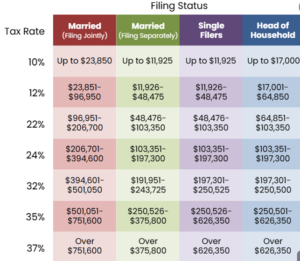
2025 Federal Income Tax Brackets
Your federal income tax bracket is determined by two factors: your total income and your tax-filing classification.
For the 2025 tax year, there are seven tax brackets for ordinary income – ranging from 10% to 37% – and four classifications: single, married filing jointly, married filing separately, and head of household.3
1. House.gov, 2025
2. IRS.gov, 2025
3. IRS.gov, 2025